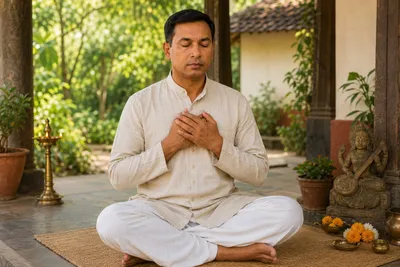
Here is a confession: for the first few years of my meditation practice, I would sit for twenty minutes in the morning, feel peaceful, and then spend the rest of the day completely on autopilot. Eating without tasting. Walking without seeing. Having conversations without really listening.
I was meditating. But I was not being mindful. There is a difference.
What Daily Mindfulness Actually Is
Mindfulness is just paying attention to what is happening right now. That is it. Not wishing things were different. Not planning the next hour. Not replaying yesterday’s conversation. Just being here, fully, with whatever is in front of you.
The opposite of mindfulness is autopilot. That state where you drive home and do not remember the journey. Where you eat lunch and cannot recall the taste. Where someone talks to you and you realise you heard nothing.
We all live in autopilot most of the time. Mindfulness is the practice of waking up — moment by moment — to your actual life.
The Anchor Point Method
Trying to be mindful every second of every day is impossible and exhausting. Do not even try. Instead, pick specific moments in your day, anchor points, where you practise full awareness.
Here is what I recommend to my students at Dibrugarh:
Mindful Eating
Pick one meal. Just one. Eat it with full attention. Notice the colours. The textures. The aromas. Chew slowly. Put your fork down between bites. Taste each mouthful.
This single practice transforms your relationship with food. And it takes no extra time. You are already eating. Just eat with awareness.
Mindful Walking
When you walk, even from one room to another, feel your feet on the ground. Notice the rhythm of your steps. The air on your skin. The details of your surroundings.
Walking to your car can become a meditation. Walking to the bus stop can be a practice. Every step is an opportunity.
Mindful Listening
In your next conversation, commit to one thing: listening completely. Do not plan your response. Do not check your phone. Do not drift to your to-do list. Just listen: to the words, the tone, the emotion underneath.
This is one of the most transformative practices I know. When someone feels genuinely heard, the entire dynamic of the conversation changes.
Mindful Waiting
Every time you wait, in traffic, in a queue, for a meeting to start, use that moment. Feel your breath. Notice your body. Look around you.
Most people fill waiting with frustration or phone-scrolling. Those moments are opportunities for presence hiding in plain sight.
The STOP Technique
When stress or distraction overwhelms you mid-day, use this:
- Stop — pause whatever you are doing
- Take a breath — one conscious breath
- Observe — notice what is happening inside you right now
- Proceed — continue with awareness
Thirty seconds. No one around you will even notice. But you will feel the shift.
Mindfulness at Work
Your workplace is full of mindfulness opportunities:
- Three conscious breaths before entering a meeting room
- Notice the sensation of your fingers on the keyboard while typing
- During phone calls, focus entirely on the other person’s voice
- When overwhelmed, feel your feet flat on the floor. That grounding alone can change your state.
Build One Anchor at a Time
Do not try all of these at once. Start with one. Maybe mindful morning tea. When that becomes automatic, usually within two weeks, add another anchor.
Within a few weeks, mindfulness becomes part of how you move through the day, not something you have to remember to do.
The Ripple Effect
I have noticed something beautiful with my students at Dibrugarh University. Those who start with formal meditation naturally extend awareness into their daily lives. And those who start with daily mindfulness naturally deepen their formal sitting practice. The two feed each other in a cycle of increasing presence.
Right Now
Whatever you are doing, reading this, do it fully. Notice the screen. Feel your body in the chair. Hear the sounds around you. You are already mindful.
The practice is simply remembering to stay this way.
For deeper formal practice, explore Morning Meditation Routine and Vipassana Meditation Guide.