The first time I tried to meditate, I lasted about ninety seconds. My mind was racing. I was thinking about lunch, about a phone call I needed to make, about whether I was doing it right. I opened my eyes and thought, “I am terrible at this.”
I was wrong. I was doing exactly what every beginner does. And that is perfectly fine.
What meditation actually is
Let me clear up the biggest misconception right now: meditation is not about stopping your thoughts. If someone tells you to “empty your mind,” they have either never meditated or they are misleading you.
Meditation is about observing your thoughts without getting tangled up in them. You are learning to sit in the audience of your own mind, watching the show without jumping onto the stage. Thoughts will come. That is what minds do. Your job is not to fight them. Your job is to notice them and let them pass.
How to sit
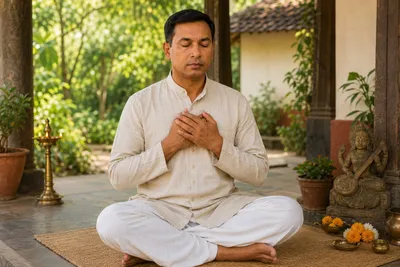
Forget everything you have seen in movies. You do not need to sit in a lotus position on a mountain. Sit in any position that keeps your spine reasonably straight and does not cause pain:
- A cushion on the floor with legs crossed
- A chair with feet flat on the ground
- A meditation bench if kneeling feels natural
The balance is between comfort and alertness. Too comfortable and you will fall asleep. Too rigid and you will be distracted by discomfort. Find the middle.
The practice I teach
This is the same method I teach beginners at Hem’s Academy in Dibrugarh. It is simple. That is the point.
- Sit comfortably — spine straight, shoulders relaxed, hands resting naturally
- Close your eyes — gently. Not squeezed shut. Soft.
- Watch your breath — do not control it. Just observe the natural rhythm.
- Notice when your mind wanders — it will. Within seconds, probably. That is normal.
- Gently bring attention back to the breath — no frustration. No judgement. Just come back.
- Continue for 5-10 minutes — use a timer so you are not peeking at the clock.
That is the whole practice. Notice your breath. Notice your mind wandered. Come back. Repeat.
Every time you bring your attention back, that is one repetition. That is the exercise. Not the focus — the returning.
Mistakes I see every week
I have taught hundreds of students. These mistakes come up every single time:
- “I cannot stop thinking”: You are not supposed to. Thoughts are not the enemy. Getting lost in them is the habit you are breaking.
- “I am doing it wrong”: If you noticed your mind wandered and brought it back, you did it right. That is the entire practice.
- “Nothing is happening”: The changes are subtle at first. More calm. Better sleep. Less reactivity. You will not notice them in the moment — you will notice them in how your week goes.
- Starting too long: Five minutes is perfect. Do not sit for thirty minutes on day one and then never sit again.
- Skipping days: Five minutes every day beats one hour once a week. Consistency is everything.
Building the habit
The best time is early morning, before the world starts demanding things from you. But any consistent time works.
Here is a trick that helped my students: link meditation to something you already do every day. Brush your teeth, then sit. Make your morning tea, then sit. This “habit stacking” makes the practice automatic within a few weeks.
Same time. Same place. Every day. Your brain starts to expect it.
What to expect
In the first two weeks, you will feel restless. You will wonder if you are doing it right. You will get bored. Your legs might ache. Your mind will produce every possible distraction.
This is normal. Your mind has been running unsupervised for decades. It does not want to be watched. It will resist.
Stay with it.
Within three to four weeks, most of my students report something subtle but real: a bit more space between stimulus and reaction. A slight reduction in mental noise. Better sleep. Nothing dramatic. Just a quiet shift.
Where to go from here
Once basic breath observation feels comfortable — usually after a few weeks — you can explore deeper. Vipassana meditation offers a systematic path. Mindfulness practice extends awareness into daily life. I teach both through my programmes in Dibrugarh.
But do not rush. Master sitting with your breath first. Everything else builds on that foundation.
Do this right now
Set a timer for five minutes. Close your eyes. Watch your breath. When your mind wanders — and it will — gently come back.
When the timer rings, you have meditated. That is all it takes to begin.
For deeper exploration, read Morning Meditation Routine and Vipassana Meditation Guide.